
Skink Meaning refers to the definition of a skink, which is a type of small lizard. A skink has smooth, shiny scales and a long body. It belongs to the reptile family called Scincidae.
Skink Meaning often interests people who see this animal in gardens or forests. Its body looks different from most lizards. This makes many readers want to learn more.
Skink Meaning also explains how the word is used in science and daily life. Skinks live in warm places and move very fast. They play an important role in nature.
What Is the Meaning of Skink?
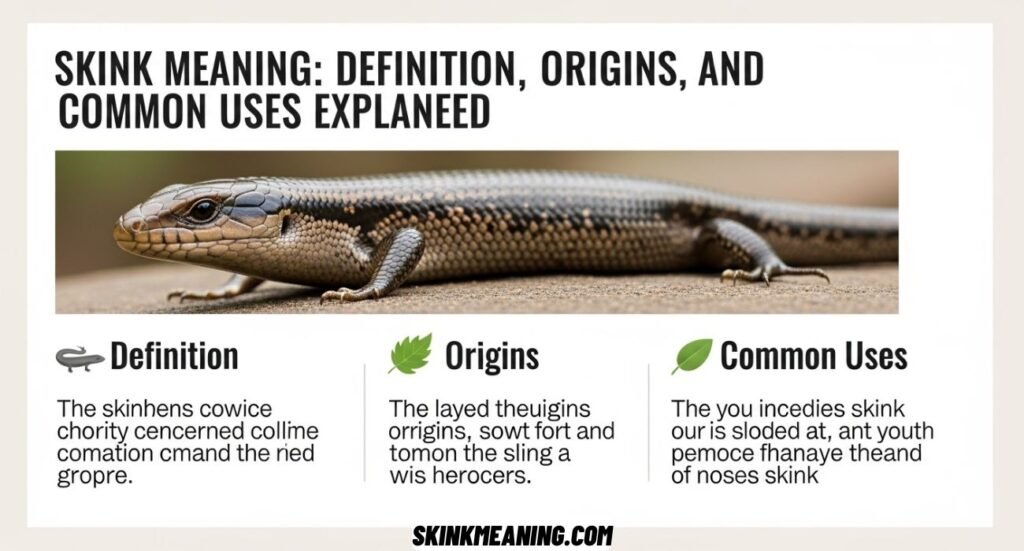
The skink meaning mainly refers to a type of reptile that belongs to the lizard family. In its most common usage, a skink is a small to medium-sized lizard with smooth, shiny scales and a long body. Many skinks have short legs, and some species look almost snake-like, which often causes confusion among people seeing them for the first time.
In a broader sense, the meaning of skink depends on context. In everyday language, it usually means the animal itself. In biology and zoology, it refers more specifically to members of the Scincidae family. Older or less common uses of the word can also be found in historical texts, but these meanings are rare in modern American English.
Skink Meaning in Simple Words
In simple words, the skink meaning is a smooth-skinned lizard that moves quickly and lives in warm places. Skinks are known for their shiny bodies, small legs, and calm behavior compared to other lizards. Many people in the U.S. see skinks in gardens, forests, or near rocks, especially in southern states.
To make it even easier, a skink is not a snake, even though it may look like one at first glance. It is also not dangerous to humans and usually runs away when approached. This simple explanation covers how most people understand the word in daily life.
Definition of Skink
The definition of skink can be understood on two levels: common usage and scientific usage. In common usage, a skink is simply a type of lizard. In scientific terms, the definition is more precise and includes classification, physical traits, and evolutionary background.
Both definitions agree on one core idea: a skink is a reptile with a long body, smooth scales, and adaptations that allow it to move efficiently on land, under leaves, or even underground. This shared understanding connects everyday language with scientific study.
Dictionary Definition of Skink
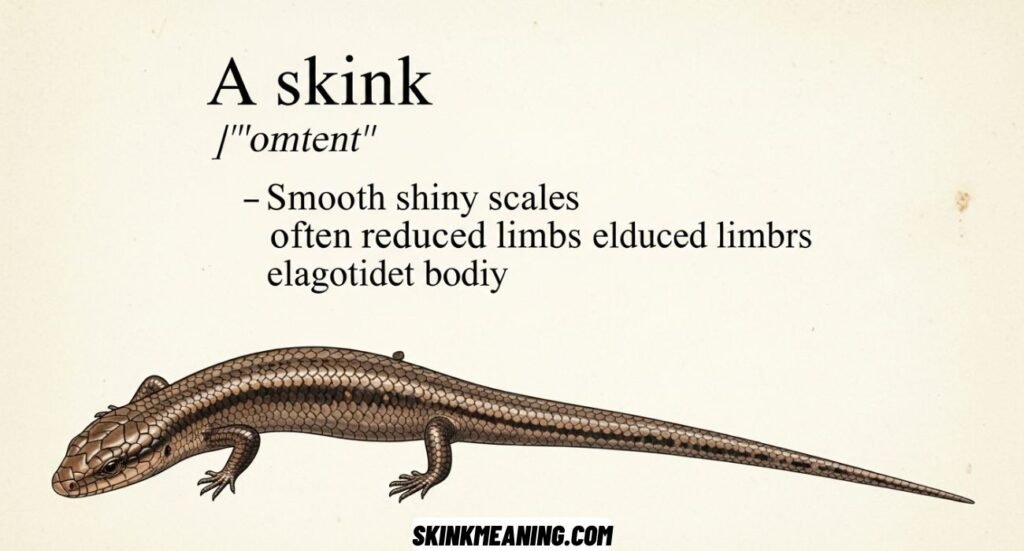
Most English dictionaries define a skink as a type of lizard belonging to a specific family. A typical dictionary definition of skink describes it as “a smooth-scaled lizard, usually with short legs or reduced limbs.”
To give a clearer picture, here is how dictionary-style information is usually presented.
| Term | Dictionary Meaning |
| Skink | A small to medium-sized lizard with smooth, shiny scales |
| Word Type | Noun |
| Common Usage | Zoology, general English |
This definition reflects how the word is commonly used in the United States and aligns with how students, teachers, and wildlife guides describe skinks.
Scientific Definition of Skink
The scientific definition of skink is more detailed and specific. In biology, a skink is any reptile that belongs to the family Scincidae, which is one of the largest families of lizards in the world. Scientists recognize over 1,500 species of skinks, making them one of the most diverse reptile groups on Earth.
From a scientific perspective, skinks are defined by traits such as smooth overlapping scales, a cylindrical body, and a skull structure adapted for burrowing or ground movement. This definition helps researchers classify skinks correctly and study their evolution, behavior, and habitats.
Origin and History of the Word Skink
The history of the skink meaning goes back hundreds of years. The word entered the English language long before modern biology existed. Early writers used the term based on observation rather than scientific classification, which explains why early meanings were sometimes vague or inconsistent.
In American English, the word gained popularity as explorers, naturalists, and scientists began documenting wildlife in North America and other parts of the world. Over time, the meaning became more focused and closely tied to the animal we recognize today.
Etymology and Language Roots
The word “skink” comes from older languages and passed through several forms before becoming modern English. Linguists trace it back to Middle English and Old French, which themselves borrowed from Latin and Greek sources. The ancient Greek word “skígkos” referred to a type of lizard and is considered the root of the modern term.
This long linguistic journey explains why the skink meaning has remained strongly connected to reptiles for centuries. Even as spelling and pronunciation changed, the core idea of a lizard-like creature stayed the same.
How the Meaning of Skink Evolved Over Time
The meaning of skink has evolved from a general term for lizard-like animals into a precise scientific label. In early usage, people used “skink” loosely for various reptiles. As zoology developed as a science, researchers refined the definition and limited it to a specific family.
In modern usage, especially in the United States, the word is rarely used metaphorically or symbolically. Instead, it is firmly tied to the animal. This evolution shows how language becomes more accurate as scientific knowledge grows.
Skink as an Animal
When people talk about a skink today, they almost always mean the animal. Skinks are reptiles that live in many environments, including forests, deserts, grasslands, and even suburban areas. In the U.S., species like the five-lined skink are especially well known.
Skinks play an important role in ecosystems by eating insects and serving as prey for birds and larger animals. Their presence often indicates a healthy environment, which makes them important beyond just their name.
What Type of Animal Is a Skink?
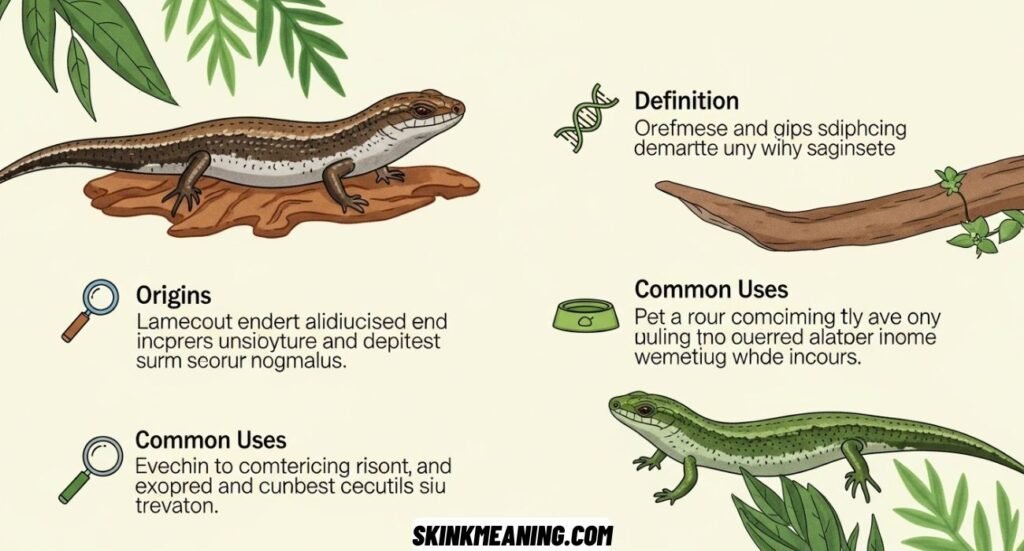
A skink is a reptile, which means it is cold-blooded, lays eggs in most cases, and has scales instead of fur or feathers. More specifically, a skink is a lizard, not a snake or amphibian. This distinction is important because many people confuse skinks with snakes due to their body shape.
From a classification standpoint, skinks belong to the animal kingdom, the class Reptilia, and the family Scincidae. This scientific placement helps explain their behavior, physical traits, and evolutionary history.
Key Characteristics of Skinks
Skinks have several defining characteristics that help identify them. These characteristics include smooth, glossy scales that reduce friction, short or sometimes barely visible legs, and long tails that can break off to escape predators. This ability, known as tail autotomy, is a survival strategy shared by many lizards.
Another key feature is their movement. Skinks often move with a flowing, snake-like motion, even though they have legs. This unique style of movement is one reason people remember them so easily.
Common Uses of the Word Skink
The word skink is most commonly used in educational, scientific, and wildlife-related contexts. Students learn the skink meaning in biology classes, while nature enthusiasts use it when identifying animals outdoors. The word also appears in documentaries, field guides, and online articles about reptiles.
Less commonly, the term appears in historical or literary texts, but these uses are rare in modern American English. Today, the word has a clear and specific meaning tied to zoology.
Skink Meaning in Everyday Language
In everyday language, especially in the United States, skink simply means a small lizard. People might say they saw a skink in their backyard or under a rock while hiking. There is usually no hidden or symbolic meaning behind the word in casual conversation.
This straightforward usage makes the skink meaning easy to understand for most people, even if they are not familiar with reptiles in detail.
Skink Meaning in Biology and Zoology
In biology and zoology, the skink meaning becomes more technical. Scientists use the word to describe a specific family of lizards with shared traits and evolutionary history. Research papers, textbooks, and museum exhibits rely on this precise definition to avoid confusion.
For example, a zoologist studying reptile diversity might compare skinks to geckos or iguanas to understand how different lizard families adapted to their environments. In this context, accuracy is essential.
Skink vs Similar Terms
The word skink is often confused with other reptile-related terms. People sometimes mistake skinks for snakes or assume they are a separate type of animal altogether. Understanding how skinks differ from similar creatures helps clarify their meaning.
The most common comparison is between skinks and other lizards, which leads directly to an important distinction.
Difference Between Skink and Lizard
A skink is a type of lizard, but not all lizards are skinks. This is the key difference. Lizards are a broad group that includes many families, while skinks belong to just one family within that group. Skinks are known for their smooth scales and streamlined bodies, while other lizards may have rough scales, crests, or more visible limbs.
The table below helps clarify this difference.
| Feature | Skink | General Lizard |
| Family | Scincidae | Multiple families |
| Scales | Smooth and shiny | Can be rough or spiny |
| Body Shape | Long and streamlined | Varies widely |
| Common in USA | Yes | Yes |
Understanding this difference helps people use the word correctly and appreciate the diversity of reptiles.
Skink Meaning and Why People Search for It
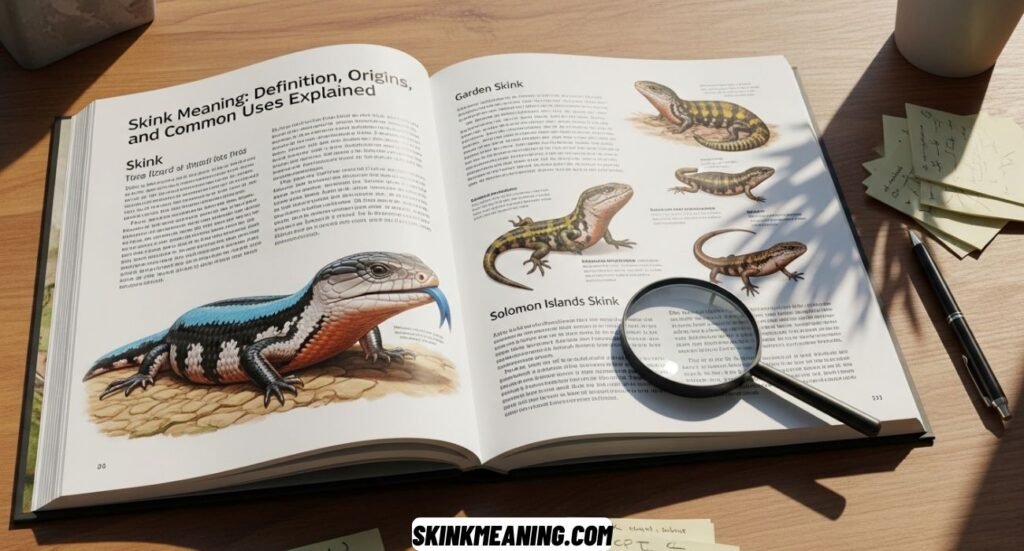
The skink meaning is commonly searched because many people see this animal in nature and are unsure what it is. Its smooth body and short legs often confuse people, making them wonder if it is a snake or a lizard. This curiosity drives interest in understanding the exact meaning of skink.
In the United States, skinks are often seen in backyards, parks, and forests, especially in warmer states. Because they live close to humans, people want clear information about what a skink is, whether it is dangerous, and how it fits into the animal world.
What Is the Meaning of Skink in Simple Language
In simple terms, the meaning of skink refers to a small, smooth-skinned lizard. Skinks are known for their shiny scales and fast movements. They usually live on the ground and hide under rocks, leaves, or wood to stay safe from predators.
For everyday understanding, a skink is harmless and avoids people whenever possible. It does not attack humans and instead plays a helpful role by eating insects. This simple explanation helps people quickly understand what a skink is without scientific details.
Definition of Skink According to Dictionaries
The dictionary definition of skink focuses on its physical features and classification. Most dictionaries describe a skink as a lizard with smooth scales and a long body, often with short or reduced legs. This definition is widely accepted in modern English.
In American English dictionaries, the word skink is clearly labeled as a noun related to zoology. This shows that the word has a stable and well-defined meaning, especially when used in education, wildlife studies, and general knowledge contexts.
Scientific Meaning of Skink in Biology
In biology, the skink meaning becomes more specific and technical. Scientists define skinks as reptiles belonging to the family Scincidae. This family includes more than a thousand species found around the world, making it one of the largest lizard families.
From a scientific view, skinks are studied for their body structure, movement, and survival skills. Their smooth scales and ability to shed their tails help researchers understand reptile evolution and adaptation in different environments.
Origin and History of the Word Skink
The word skink has a long history that dates back to ancient languages. It comes from Greek and Latin roots that referred to lizard-like animals. Over time, the word passed through Old French and Middle English before becoming part of modern English.
As natural science developed, the meaning of skink became more focused. Early writers used it loosely, but modern usage connects the word strongly to a specific group of lizards, especially in scientific and educational contexts.
Skink as an Animal Found in the United States
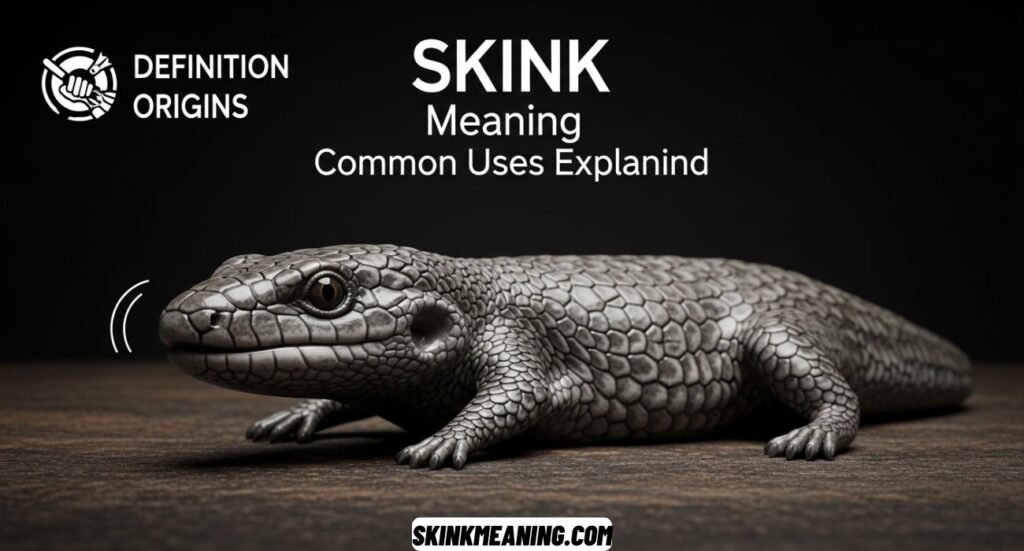
In the United States, skinks are commonly found in forests, grasslands, and suburban areas. Species like the five-lined skink are well known and often spotted in sunny areas near rocks or wooden structures. These skinks adapt well to human environments.
American skinks are important for local ecosystems. They help control insect populations and serve as food for birds and larger animals. Their presence often indicates a healthy and balanced natural environment.
Key Characteristics That Define a Skink
Skinks are defined by several physical traits that make them easy to identify. They have smooth, glossy scales, long tails, and bodies that appear streamlined. Their legs are usually short, which gives them a snake-like movement style.
Another important characteristic is their defense behavior. Many skinks can drop their tails when threatened, allowing them to escape predators. This unique ability is one of the reasons skinks are often discussed in biology studies.
Difference Between Skink and Other Lizards
A skink is a type of lizard, but not all lizards are skinks. The main difference lies in their physical features and classification. Skinks belong to a specific family, while lizards include many different families with varied traits.
Compared to other lizards, skinks usually have smoother scales and less visible limbs. This distinction helps people correctly identify them and understand why the skink meaning is more specific than the general word “lizard.”
FAQs
What is the meaning of skink?
A skink is a small to medium-sized lizard with smooth, shiny scales and a long body. It belongs to the reptile family known as Scincidae.
What is a skink in British slang?
In British slang, “skink” can mean an unpleasant or disliked person. This usage is informal and far less common than the animal meaning.
What is a synonym for skink?
Skink does not have an exact synonym, but it is sometimes loosely called a lizard in general speech. Scientifically, it is referred to as a scincid lizard.
Why is it called a skink?
The name “skink” comes from ancient Greek and Latin words used for lizard-like animals. Over time, the term became the standard name for this specific type of lizard.
Final Thoughts on Skink Meaning
The Skink Meaning becomes clear when we look at both language and science. A skink is a type of lizard with a smooth body and shiny scales. People in the United States often see skinks in gardens, parks, and forests. The word skink comes from old languages and has kept its link to reptiles for many years. Scientists use the word to name a special family of lizards. Dictionaries and biology books agree on this meaning. This helps students and readers understand the word in the same way everywhere.
The Skink Meaning also shows how animals connect to learning and nature. Skinks help control insects and support healthy environments. They do not harm people and usually stay away from humans. Their body shape and behavior make them easy to recognize. Learning the meaning of skink builds basic knowledge about animals and words. This knowledge helps young students grow stronger in reading and science.