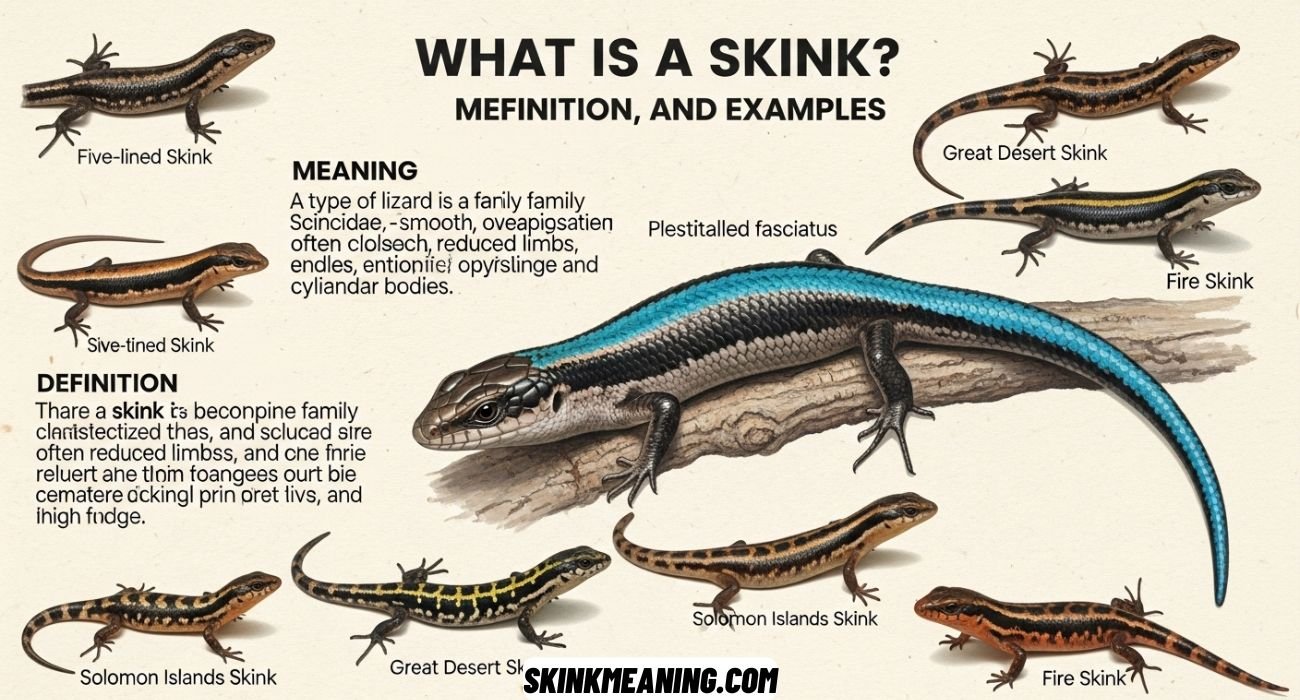
What Is a Skink? Meaning, Definition, and Examples
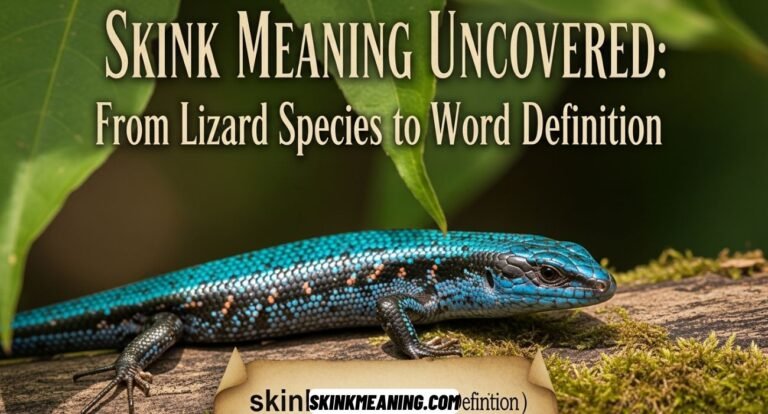
The Skink Meaning Definition explains that a skink is a small reptile with smooth and shiny skin. A skink belongs to the lizard family called Scincidae and lives on land. It moves very fast and uses its short legs to escape danger.
The Skink Meaning Definition often surprises young readers and students. Many people think skinks are snakes because of their long bodies. Their bright colors and quick movement easily catch attention.
The Skink Meaning Definition helps students learn basic facts about reptiles. Skinks eat insects and help keep the environment clean. They live in forests, gardens, and other warm places.
What Is a Skink?
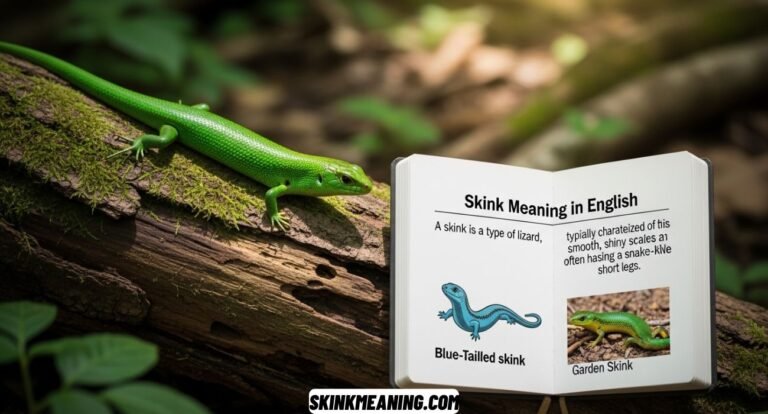
A skink is a type of lizard that belongs to a large reptile family called Scincidae. When people ask what is a skink, the simplest answer is that it is a smooth-scaled lizard with a long body and short legs, although some skinks have very tiny legs or none at all. Skinks are known for their shiny appearance, quick movements, and ability to adapt to many environments.
In the United States, skinks are commonly seen in forests, deserts, grasslands, and even suburban areas. Many Americans first notice skinks when they see a bright blue-tailed juvenile skink darting across a backyard or hiking trail. Skinks play an important role in ecosystems because they help control insect populations and serve as prey for birds and other animals.
Skink Meaning in Simple Terms
The skink meaning in simple terms is a small to medium-sized lizard that looks smooth and shiny and moves very fast. Unlike rough or spiky lizards, skinks usually have sleek bodies that help them slide easily through grass, soil, and leaf litter.
People often confuse skinks with snakes because some skinks have very small legs. However, skinks are true lizards, not snakes. They have eyelids, external ear openings, and usually visible legs, which snakes do not have. In everyday language, when someone says “skink,” they are almost always talking about this fast-moving, smooth-skinned reptile.
Definition of Skink
The definition of skink can be understood in both general and scientific ways. In common usage, a skink is defined as a lizard with smooth scales, a long tail, and a streamlined body. This definition focuses on what people can easily observe.
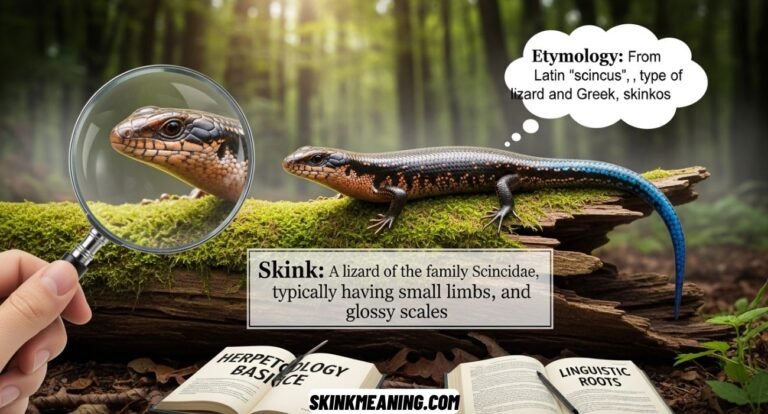
From a biological perspective, a skink is a reptile that belongs to the family Scincidae, which is one of the largest lizard families in the world. This family includes more than 1,500 known species, making skinks incredibly diverse in size, color, and behavior.
Dictionary Definition of Skink
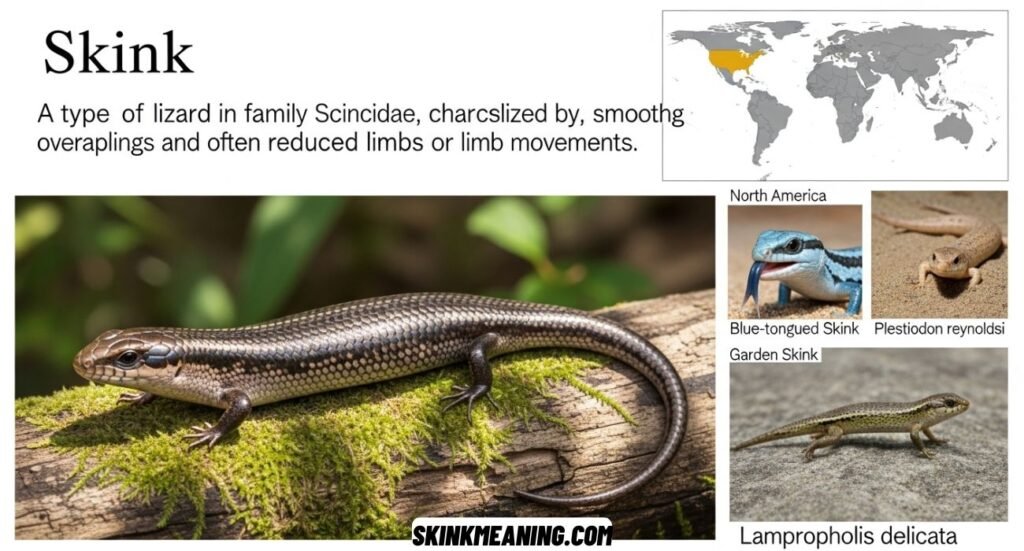
According to standard English dictionaries, the word “skink” is defined as a type of lizard characterized by smooth, overlapping scales and a cylindrical body. Most dictionary definitions also mention that skinks are found in warm regions across the world.
These definitions are short and simple, but they highlight the key features that make skinks unique. Smooth scales, a long body, and lizard classification are always included when defining a skink in a dictionary.
Scientific Definition of Skink
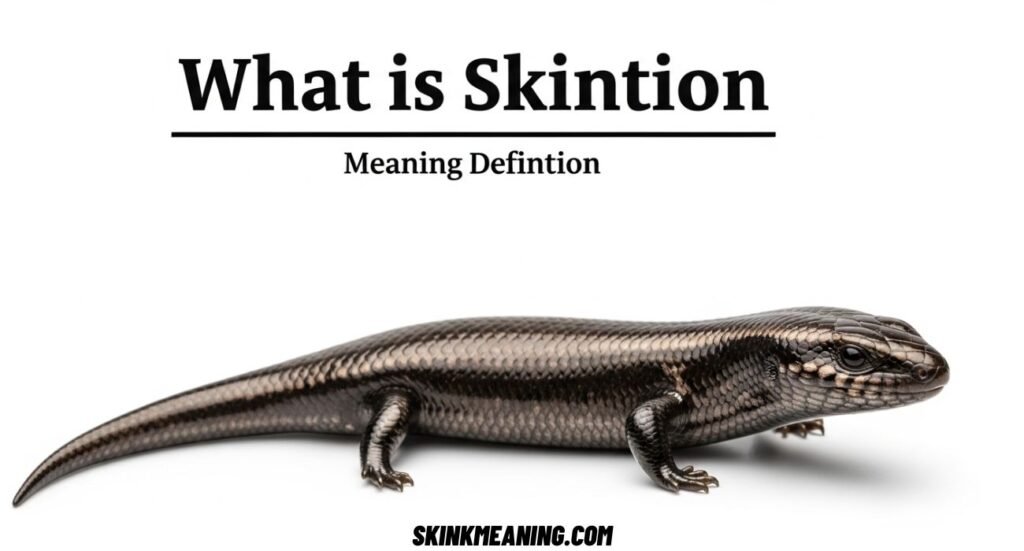
The scientific definition of skink goes deeper and focuses on classification and anatomy. Scientifically, a skink is any lizard species belonging to the family Scincidae, within the order Squamata. Skinks are ectothermic animals, meaning they rely on external heat sources like the sun to regulate their body temperature.
Scientists define skinks by specific traits such as their osteoderms, which are bony structures under their scales, and their skull shape. These features help researchers distinguish skinks from other lizard families. In scientific studies, skinks are often used to understand evolution, limb reduction, and reptile adaptation.
Origin of the Word Skink
The word “skink” has an interesting linguistic history. The origin of the word skink can be traced back to ancient languages used in Europe and the Mediterranean region. Over time, the word evolved and became part of the English language.
Early English speakers used the word “skink” to describe certain types of lizards that looked slippery or shiny. The name likely stuck because it matched the animal’s smooth appearance and quick movements.
Etymology and Historical Background
The etymology of skink comes from the Greek word skinkos, which referred to a type of lizard believed to have medicinal properties in ancient times. The word later passed into Latin and then into Old French before entering Middle English.
Historically, skinks were sometimes mentioned in medical texts and folklore. In medieval Europe, powdered skink was once believed to be a cure for various illnesses, although modern science has proven these beliefs to be myths. This historical background shows that skinks have fascinated humans for centuries, not just as animals but also as symbols in culture and medicine.
Skink as an Animal
When discussing skink as an animal, it is important to understand its role in nature. Skinks are reptiles, which means they are cold-blooded, lay eggs or give live birth depending on the species, and have scaly skin.
Skinks are generally shy and non-aggressive. Most species prefer to escape rather than confront threats. They are active during the day and spend much of their time basking in sunlight to warm their bodies. As animals, skinks are excellent survivors and have adapted to environments ranging from rainforests to deserts.
What Kind of Animal Is a Skink?

So, what kind of animal is a skink? A skink is a reptile, a lizard, and a vertebrate. It belongs to the same broad group as snakes and geckos but has its own unique family.
Skinks are not mammals, amphibians, or insects. They breathe air, have lungs, and are covered in scales rather than fur or feathers. In the animal kingdom, skinks are classified as reptiles that have evolved to be fast, flexible, and highly adaptable.
Physical Characteristics of Skinks
The physical characteristics of skinks are one of the easiest ways to identify them. Most skinks have smooth, shiny scales that overlap like tiles. Their bodies are usually long and narrow, and their legs are short compared to other lizards.
Skinks come in many colors, including brown, black, gray, green, and even bright blue. Juvenile skinks often have blue tails, which can detach if grabbed by a predator. This process, called autotomy, allows the skink to escape while the tail continues to move and distract the attacker.
Types of Skinks
There are many types of skinks, and they vary widely in size, habitat, and behavior. Some skinks are only a few inches long, while others can grow over two feet in length.
To better understand the diversity of skinks, the following table shows a comparison of different types based on size and habitat.
| Type of Skink | Average Size | Common Habitat |
| Blue-tailed skink | Small to medium | Forests and gardens |
| Five-lined skink | Medium | Woodlands in the USA |
| Giant skink | Large | Islands and tropical regions |
| Desert skink | Medium | Sandy deserts |
This table shows how skinks can adapt to very different environments while still sharing the same basic body structure.
Common Skink Species Found Worldwide
There are many common skink species found worldwide, and several are familiar to people in the United States. The five-lined skink is one of the most well-known species in North America. It is often seen in wooded areas and is easily recognized by its stripes and blue tail when young.
Other common species live in Australia, Africa, Asia, and island ecosystems. Australia alone is home to hundreds of skink species, making it one of the most skink-rich regions in the world.
Examples of Skinks
When discussing examples of skinks, it helps to look at specific species that people might recognize. Examples include the five-lined skink in the eastern United States, the western skink found in the western states, and the blue-tongued skink from Australia.
Each example shows how skinks can look and behave differently while still fitting the same definition. Some are small and secretive, while others are large and relatively bold.
Skink Examples in Nature and Habitats
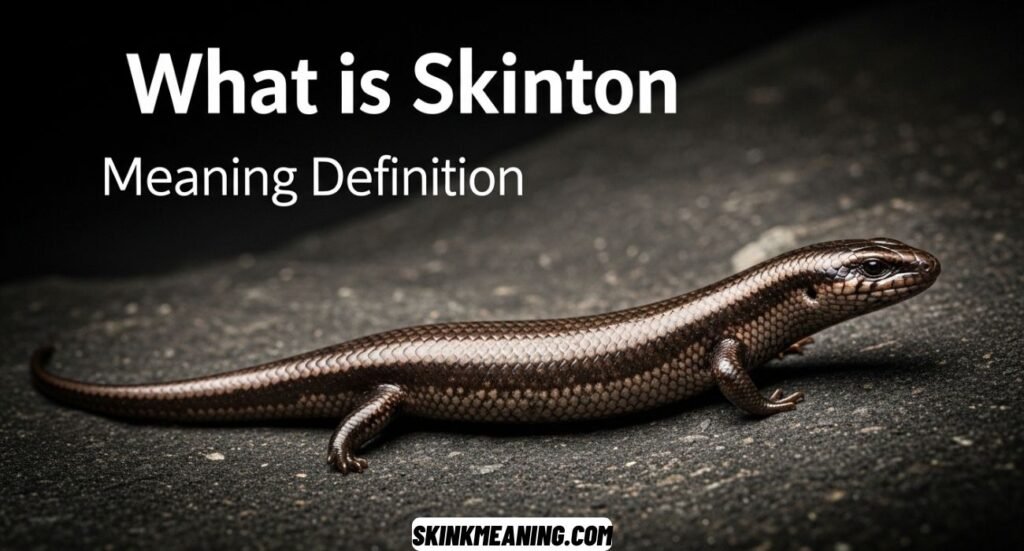
Skink examples in nature and habitats show just how adaptable these lizards are. Skinks can be found living under rocks, inside logs, beneath leaf litter, and even near human homes. In forests, they help control insect populations. In deserts, they survive extreme heat by burrowing into sand.
A simple case study from the southeastern United States shows that five-lined skinks often thrive in suburban neighborhoods where fallen logs and garden mulch provide shelter. This demonstrates how skinks can coexist with humans without causing harm.
Skink vs Other Lizards
When comparing skink vs other lizards, the biggest differences are body shape and movement. Skinks usually have smoother scales and a more snake-like motion compared to other lizards like iguanas or anoles.
Many lizards rely on climbing or jumping, while skinks are more likely to run quickly along the ground. Their streamlined bodies allow them to move through tight spaces with ease.
Difference Between a Skink and Other Lizards
The difference between a skink and other lizards can be summarized by anatomy and behavior. Skinks have smooth, shiny scales, short legs, and long bodies, while many other lizards have rough scales, longer legs, or specialized features like crests.
Another key difference is how skinks defend themselves. Tail shedding is especially common in skinks, and their tails often regrow over time. This adaptation makes them highly effective at escaping predators.
Read Also : Skink Meaning in English: Simple Explanation with Examples
What Is a Skink and Why People Are Curious About It
A skink is a type of lizard that belongs to the reptile family called Scincidae. Many people ask what is a skink because these animals look different from common lizards. Their smooth, shiny bodies and fast movements often make them stand out. In the United States, skinks are commonly seen in gardens, forests, and parks.
People are curious about skinks because they sometimes mistake them for snakes. This confusion happens due to their long bodies and short legs. However, skinks are harmless and play an important role in nature by controlling insect populations and maintaining ecological balance.
Skink Meaning in Simple and Everyday Language
The skink meaning in simple terms is a small to medium-sized lizard with smooth skin and quick movements. Unlike rough or spiky lizards, skinks look glossy and sleek. This appearance helps them move easily through grass, soil, and leaf litter without getting stuck.
In everyday language, people use the word skink to describe a fast, ground-dwelling lizard. Children often notice skinks because of their bright colors, especially the blue tails seen in young skinks. These features make skinks easy to recognize and remember.
Definition of Skink in General and Scientific Use
The general definition of skink describes it as a smooth-scaled lizard with a long tail and short legs. This definition focuses on visible features that anyone can notice. It helps people quickly understand what kind of animal a skink is without scientific knowledge.
Scientifically, a skink is defined as a reptile belonging to the family Scincidae. Scientists study skinks to understand evolution, limb development, and reptile behavior. This scientific definition is more detailed and helps classify skinks among other reptiles.
Origin and History of the Word Skink
The word skink has ancient roots that go back thousands of years. It comes from the Greek word skinkos, which referred to a type of lizard known in ancient times. Over centuries, the word traveled through Latin and Old French before entering English.
Historically, skinks were mentioned in early medical and cultural texts. Some ancient cultures believed skinks had healing powers. While these beliefs are not supported by modern science, they show that humans have been interested in skinks for a very long time.
Skink as an Animal in the Natural World
As an animal, a skink is a reptile that depends on sunlight to control its body temperature. Skinks are cold-blooded and often seen basking on rocks or logs. This behavior helps them stay active and digest their food properly.
Skinks are generally shy and avoid humans when possible. They feed on insects, spiders, and small invertebrates, which makes them helpful to ecosystems. By eating pests, skinks support healthy environments in both wild and suburban areas.
Physical Characteristics That Define a Skink
Skinks have very distinct physical characteristics that make them easy to identify. Their scales are smooth and overlapping, giving them a shiny appearance. Most skinks have long tails, which can break off if grabbed by a predator.
Their legs are usually short, and some species have extremely small limbs. This body structure allows skinks to move quickly on the ground. These physical traits help skinks survive in many different habitats around the world.
Types of Skinks Found Around the World
There are many types of skinks found across different continents. Some skinks live in forests, while others survive in deserts or grasslands. Australia is especially famous for its wide variety of skink species.
In the United States, common types include the five-lined skink and the western skink. Each type has unique colors and behaviors, but all share the basic features that define skinks as a group of lizards.
Difference Between a Skink and Other Lizards
The difference between a skink and other lizards is mainly seen in body shape and movement. Skinks have smoother scales and more flexible bodies than many other lizards. This gives them a snake-like motion when they move.
Other lizards often climb trees or walls, while skinks prefer to stay on the ground. Skinks are also more likely to use tail shedding as a defense method. These differences make skinks unique among lizard species.
FAQs
Are skinks good or bad?
Skinks are good and harmless reptiles that help control insects and pests. They are beneficial to gardens and natural ecosystems.
What is the difference between a lizard and a skink?
A skink is a type of lizard, but it has smoother scales, shorter legs, and a more streamlined body than most other lizards.
Is a skink aggressive?
Skinks are not aggressive and usually try to run away when threatened. They only bite in rare cases when handled roughly.
Is it safe to pick up a skink?
It is generally safe, but not recommended, because skinks can drop their tails when stressed. It is best to observe them without touching.
Final Thoughts
Skinks are small reptiles with smooth skin and fast movement. The Skink Meaning Definition explains that a skink is a type of lizard that belongs to the family Scincidae. Skinks live in many places such as forests, gardens, deserts, and grasslands. They eat insects and help keep nature clean and balanced. Many skinks live in the United States and people often see them near homes. Skinks do not cause harm to humans or pets. They prefer quiet places and hide when they feel danger. Their shiny bodies and long tails help them survive in the wild.
The Skink Meaning Definition also helps students understand how skinks differ from other lizards. Skinks have smooth scales, short legs, and strong tails. Some skinks can drop their tails to escape enemies. Skinks help science by showing how animals adapt to their environment. Learning about skinks builds respect for wildlife and nature. Skinks teach the value of balance in ecosystems. Protecting skinks supports healthy land and forests. Skinks deserve care and understanding from people.